Cobots increase efficiency and quality for company making products that protect young lives

Dorel Juvenile

Automation supports a passion for precious cargo

As its Canadian parent’s only North American manufacturing site, Columbus’ Dorel Juvenile facility produces car seats and other safety products for children. A quest for increased efficiency led the firm to cobots and delivered impact that extends beyond the production line.

Jose Garcia leaves no doubt in your mind how impressed he is with the automation that has been added to the production line at Columbus’ Dorel Juvenile facility, where he serves as plant manager.

“It’s a sexy beast,” he says. “There are four different robots in a symphony.”

Despite his obvious enthusiasm, Garcia wouldn’t swoon over any robot in any situation. Experience has taught him that it takes the right automation in the right role with the right people to get the most out of the advancements driving Industry 4.0.

As one might expect from a company tasked with saving children’s lives, Dorel Juvenile dedicates itself to engineering the safest products possible, using scientific molding processes to ensure the manufacturing process itself plays a role in product strength and durability and it employs three crash sleds on site to simulate car crashes for testing.

Over the years, the plant has sought opportunities to increase automation but has found its options limited. Because so much of the labor for Dorel Juvenile products involves working with belts and fabrics, threading them through and around plastic seats, headrests and bases, some of the processes simply can’t be automated at a high level of quality and consistency. Such challenges – and a shortage of talent who could make automation work – forced the company to abort past automation efforts.

One key that made the current automation push effective was the addition of Director of Technical Services Jeff Echler. After he joined the company in 2021, Echler reviewed the production process and identified one area where automation could work: packing and distribution. The bonus? Automation would not only increase efficiency but would also improve worker safety, make better use of the existing workforce and increase quality.

The solution: Focused automation

Because not every step of Dorel Juvenile’s production process can be automated, the company worked to get the biggest impact from the area it could automate, and to help its workforce see the benefits. 

On a production line that relies on human handwork for key activities, Dorel Juvenile knew it couldn’t automate every task, but it did recognize that automation at the end of its production line could allow it to increase efficiency and redeploy workers to more value-added tasks by relieving them of the following activities:

  • box assembly
  • placing products into boxes
  • labeling
  • putting boxes on pallets
  • labeling pallets.
  • moving filled pallets to the warehouse
“As long as you have that open communication and are able to reassure them that we’re not here to take their job away, and once they are able to experience it, people are thinking, ‘Hey, this is really cool.’”
Jeff Echler
Director of Technical Services, Dorel Juvenile

At the same time that Echler and his team identified these steps as opportunities for automation, they also recognized the limitations they faced. Space is limited in the Dorel Juvenile plant, so he had to choose equipment that wouldn’t dominate the floor or act as “monuments” that had to be worked around and that wouldn’t require a lot of safety fencing. With a need for production line flexibility, Dorel Juvenile had to have equipment that could be reconfigured and moved. Because labor – and especially skilled labor – is so hard to find, Echler sought automation that could be operated mostly by existing workers, albeit with training. He also recognized that, with products weighing up to 15 lbs., Dorel Juvenile would be stretching the capacity of many cobots and that, because Dorel strives for a one-year return on capital investments, the team had to find solutions with immediate impact.

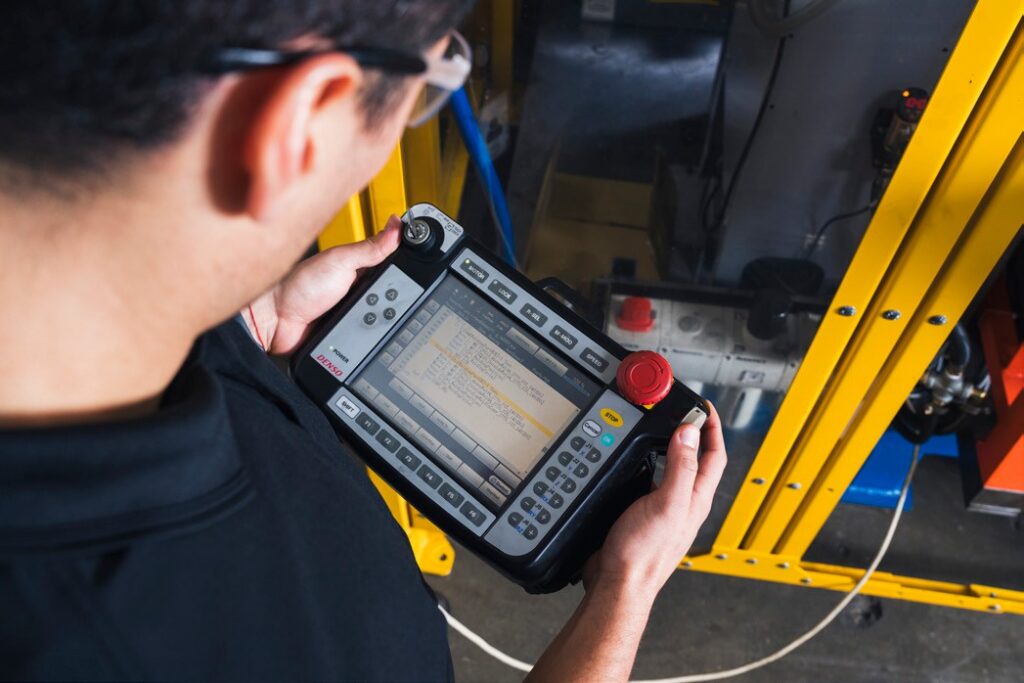
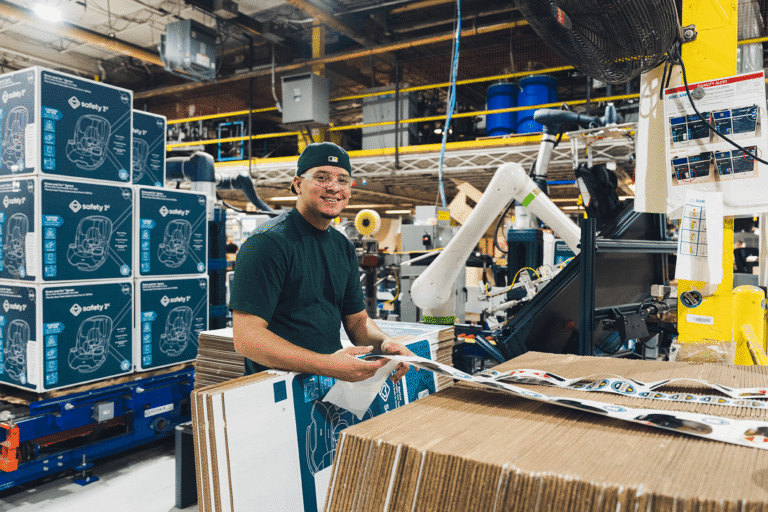
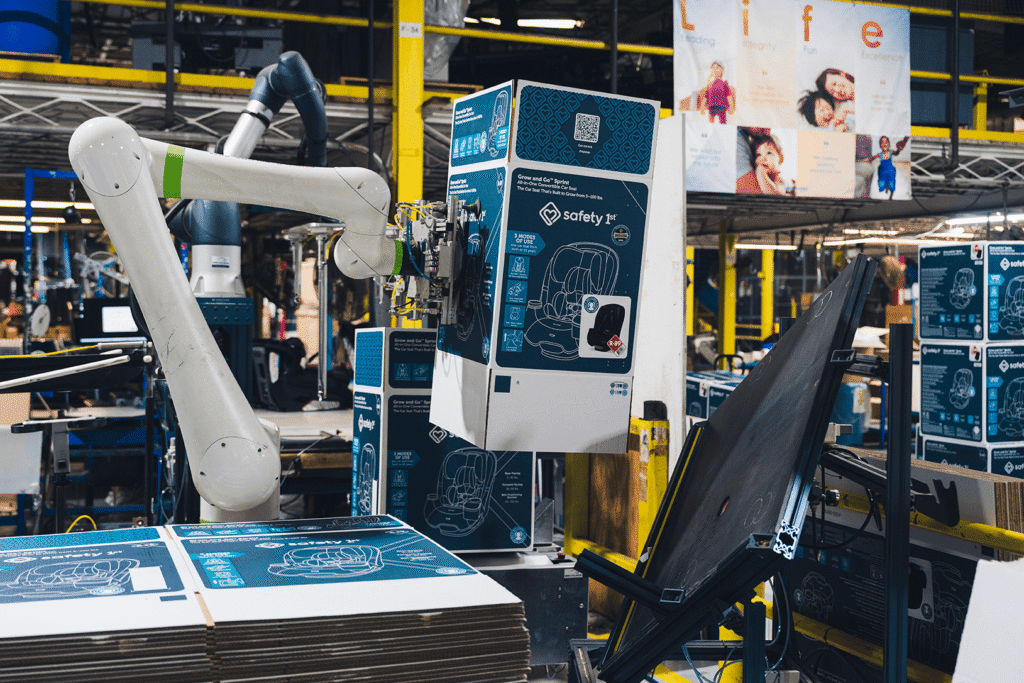
The solution for Dorel Juvenile was that “symphony” of four cobots working in collaboration with an autonomous mobile robot (AMR) at the end of the production line. The process starts when a cobot opens a flattened carboard carton into a box ready for a completed seat. Another cobot puts the seat into the box and closes it. A third cobot labels the box, and the final cobot stacks the packed, taped and labeled box onto a skid with other finished boxes. When the skid is fully loaded, the AMR moves it and replaces it with an empty one.
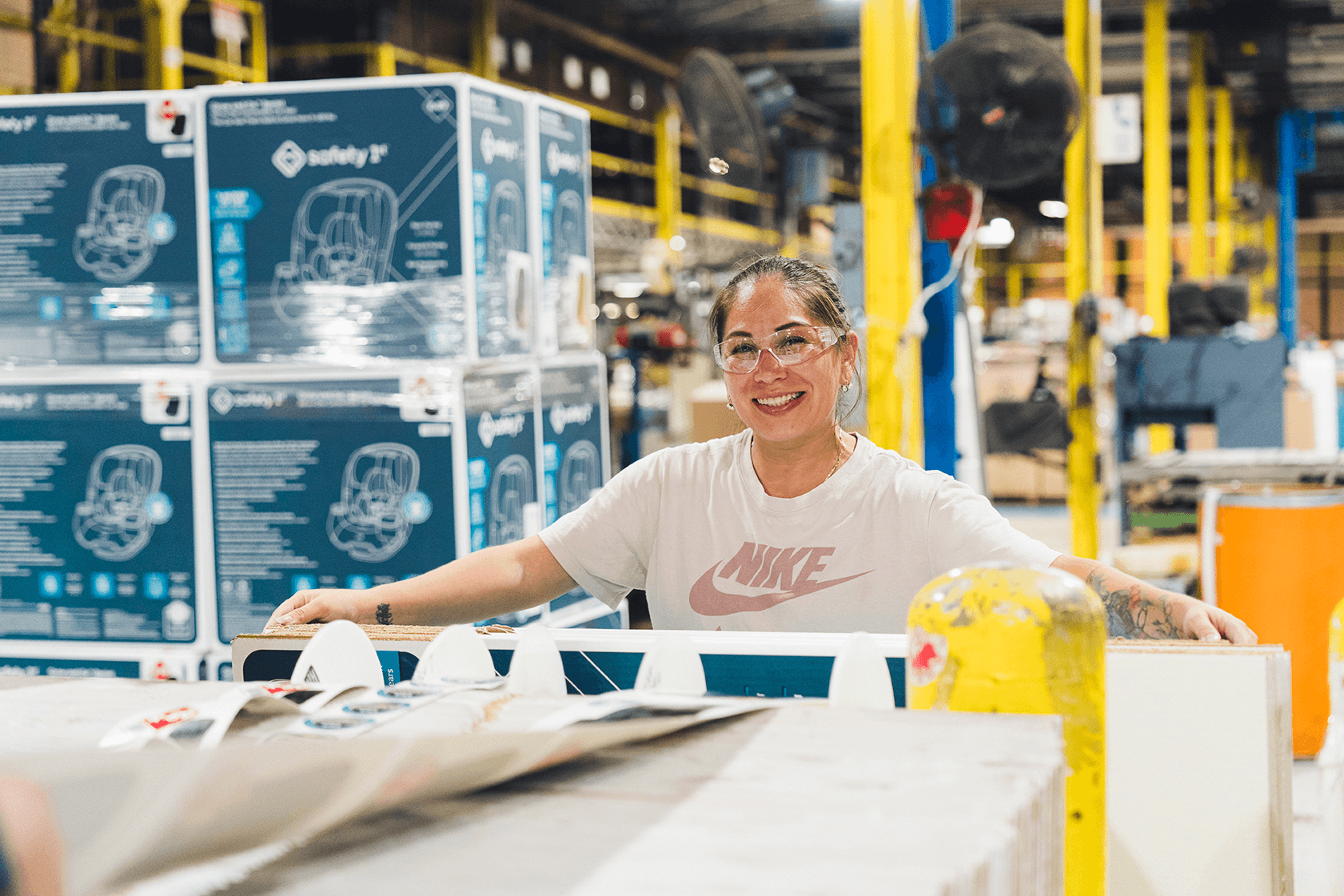
The workforce impact of this automation is multifaceted. First of all, in a market where it is difficult to hire workers, it frees people for tasks that require human skills. This reduces the pressure on Dorel Juvenile to constantly hire new workers and also provides current workers with opportunities to upskill and move into new roles. Plus, in a process that taxes the human body (Garcia points out that shoulder injuries from repetitive motion is the second most common injury among Dorel Juvenile workers), this automation protects workers from the dangers intrinsic to moving and stacking heavy.

As successful as the process has been for Dorel Juvenile, Echler is quick to say that there’s more to adding automation than buying robots. A company must be sharply aware of what the machines will be expected to do and identify how they’ll do it. Workplaces must be laid out and synchronized so robots aren’t colliding or interfering with each other. Systems must be in place for workers to communicate with automated components and for those components to communicate with each other.

Most important, Echler says, the workforce must be informed throughout the automation-adoption process and prepared for change. Workers should not be kept in the dark while automation is being investigated, only to be informed of the changes right before they occur. For Dorel Juvenile, this helped to calm fears. Sure, Echler says, some Dorel Juvenile employees initially were upset about the introduction of automation, worried that it would mean the elimination of their jobs but keeping workers aware and engaged reduced that apprehension. “As long as you have that open communication and reassure them that we’re not here to take their job away, and once they are able to experience it, people are thinking, ‘Hey, this is really cool,’” he says, “They also realize, ‘Yeah, I didn’t lose my job. I got to move to an easier job.’”
Key Learnings: Automation works, but people remain essential

Robots and cobots can do things efficiently, but they can’t share wisdom, care about customers or develop talent.

Dorel Juvenile couldn’t be happier with the return on its automation investment, but it will never pretend that robots and cobots can succeed without the right people working together toward a shared mission. Following are some lessons they shared while discussing the automation process.

Know your limitations.

As much as Dorel Juvenile had a vision for automating its operations, it also had a firm grasp of its limitations, such as space, workforce skills and budget. As a result, it didn’t acquire equipment and technology that would create more problems than solutions.

Vendors shouldn’t just sell you equipment and technology; they should provide expertise and support to make sure you get the most out of what you buy. For Dorel Juvenile, Rhino Tool House – a company Echler had worked with before – helped the team develop its automation package, design a plan for how it would work and transform that vision into reality.

Employees typically will see either danger or opportunity in automation. Show them the opportunity and you’ll help them overcome fear.


Garcia is quick to acknowledge that the automation process at Dorel Juvenile wouldn’t have happened without Echler’s background and expertise. Bringing him onboard allowed the company to do what it had attempted unsuccessfully in the past.

Don’t assume people are destined to stay in the jobs they’re hired for. Instead, watch for and cultivate people who have the capacity and desire to learn and do more, and provide opportunities for people who might otherwise get passed over. An added benefit of doing this? You’ll create loyalty that will keep people on your team.

Echler says he benefited early in his career from mentors who helped him develop into the engineer he is today. As such, he provides guidance to others. “If you’ve been rewarded by having somebody mentor and teach you and develop your skillset, to be able to pass that on is the best thing,” he says.

When Echler is working on a new idea, he not only runs it past his engineering colleagues but also shares it with his skilled trades people. This nets good ideas from both groups and builds up the team. “Having that collaboration, throughout all levels in the organization, just makes things stronger,” he says.

From its tagline (“Care for Precious Life”) to workplace conversations, Dorel Juvenile constantly reminds team members about what their product does, a practice Garcia says drives employee retention. “People know they’re making a difference,” he says. “You know, you can make car seats that are going to save little kids lives or you can go make widgets or something. We have, because of the product we make, a pretty low attrition rate.”  

When the Data Got Complicated, Yamaha Marine Turned to the Classroom

Yamaha Marine Precision Propellers, Inc.

Greenfield, Indiana

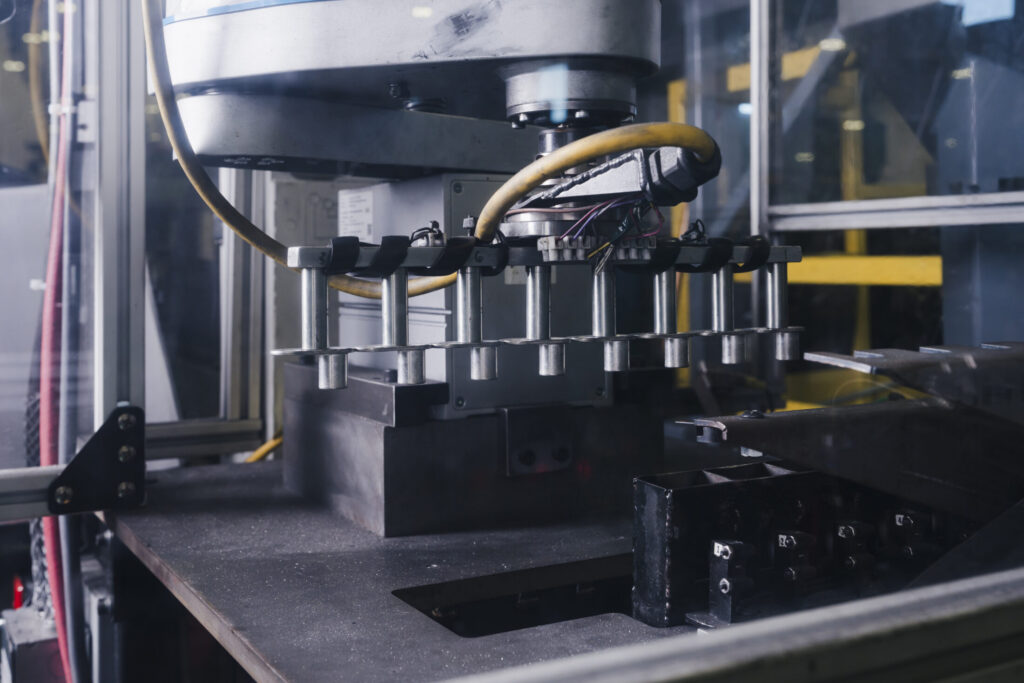
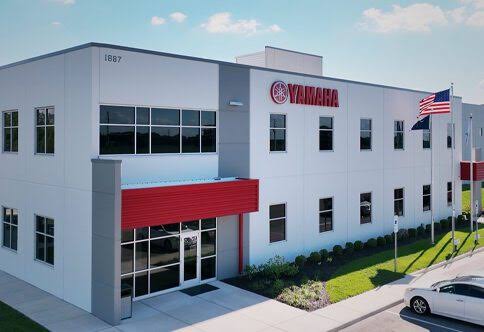
When Yamaha Marine Precision Propellers opened its new, fully automated foundry in Greenfield in 2021, the goal was straightforward: modernize a 1970s-era metal casting process and protect the company’s most valuable investment: its people. The new facility’s robotics and vision systems were built to improve safety and consistency in propeller casting.

“Automation was never about reducing headcount,” said Batuhan Ak, general manager at Yamaha Marine Precision Propellers (YPPI). “We actually gained headcount with this facility. It was about safety, efficiency and giving our people the tools to do their jobs better.”

But soon after “flipping the switch,” YPPI ran into a problem no one had planned for. The company’s scrap rate — the percentage of defective parts — climbed from 2% to more than 15%.

“We thought we took the human variable out of the equation,” Ak said. “But we didn’t account for the new variables created by automation.”

Following are highlights of how YPPI solved the problem and what other manufacturers can learn from it:

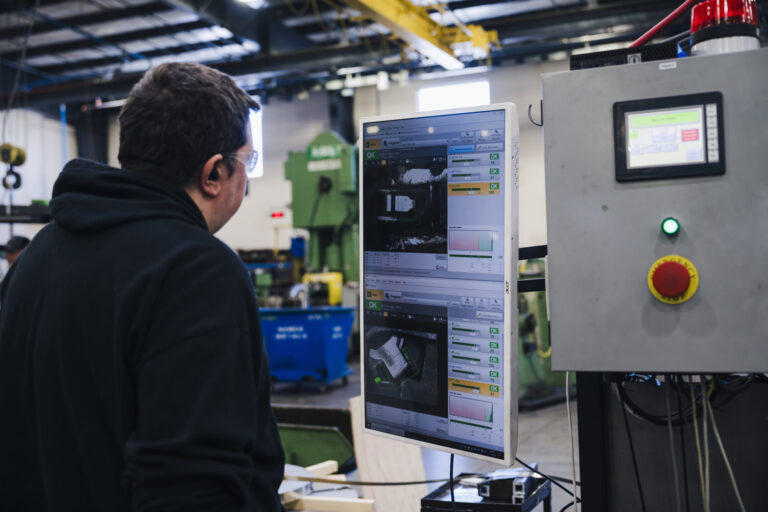
  • Data alone isn’t the answer. YPPI’s automated foundry generated vast amounts of sensor and machine data, but the company had no in-house data science expertise to make sense of it and the new robotic pouring process behaved in ways their traditional process parameters didn’t anticipate or catch.
  • Know when to look outside your own walls. Ak and his team explored outside vendors to help solve the problem, but the quotes far exceeded the budget of YPPI, a 160-person company. Rather than shelve the project, they looked for a different kind of partner.
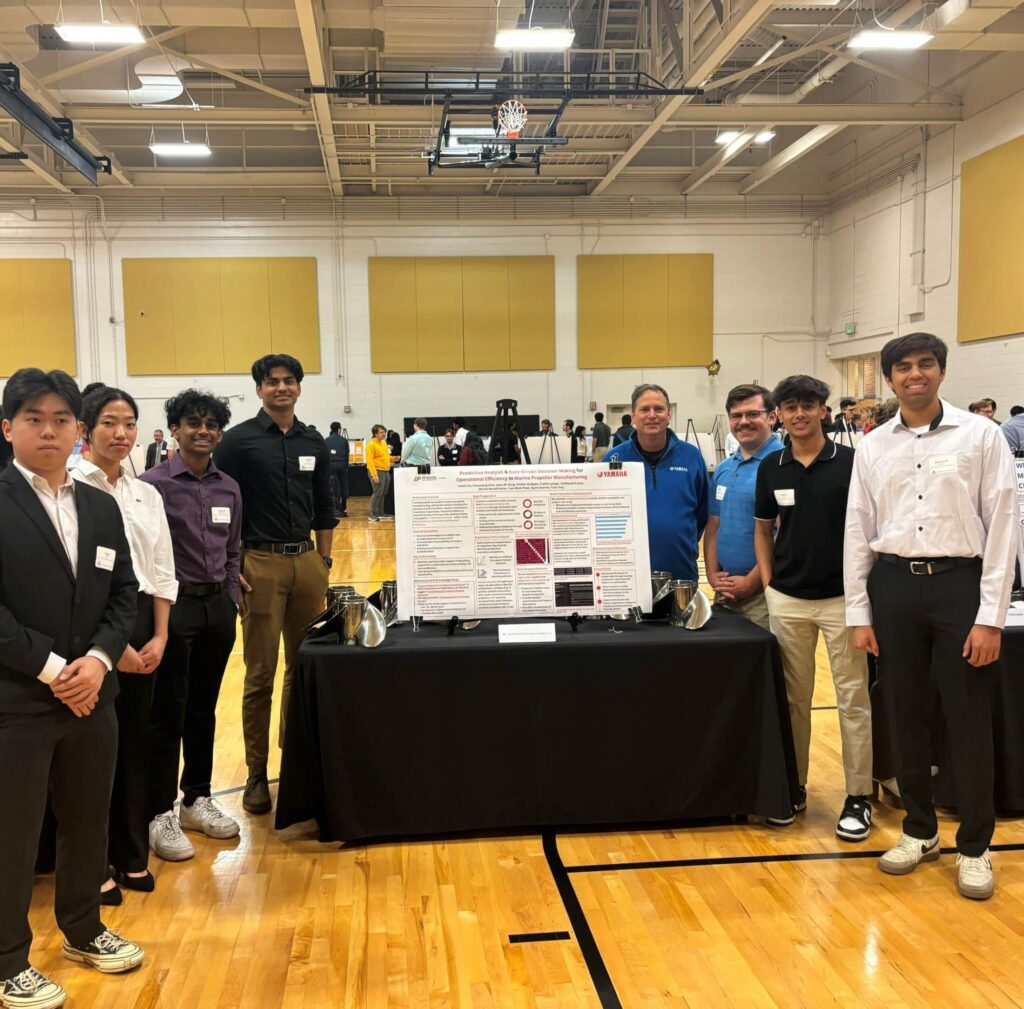
  • Partner with education to close the gap. YPPI turned to Purdue University’s Data Mine, a student-driven research and analytics program that connects Indiana companies with cross-disciplinary teams of data science and engineering students. For a modest $10,000 per semester, Yamaha and the Data Mine launched a two-year collaboration to build machine learning models that could predict scrap before it occurred.
  • Expect the first version to fall short and keep refining. “In the first year, our model had about 40% predictive accuracy,” Ak said. “But by cleaning and refining the data with Purdue’s team, we reached 94% predictive accuracy in detecting defects.” That leap translated directly into production gains: YPPI’s scrap rate dropped from more than 15% to less than 1%, saving the company more than $1 million annually.
  • Treat clean data as the real deliverable. “The cleanliness of the data was the most important lesson we learned,” Ak said. “And there has to be a functional understanding of the business in order to vet both the process during AI development and the AI’s output.” Engineers who understood the casting process stayed closely involved throughout, translating what the models found into changes on the floor.
"From a cost-savings standpoint, it's been astronomical. We're saving more than $1 million a year that used to go straight into scrap. This is the kind of return most small and mid-sized manufacturers can't afford to leave on the table."
Batuhan Ak
General Manager, Yamaha Marine Precision Propellers

YPPI’s total investment in the project — about $40,000 over two years — has returned millions in savings and safeguarded the future of its state-of-the-art facility. The company is now expanding its business, offering casting services to other manufacturers who need the same level of precision and quality it achieved through AI.

“I would be hard-pressed to think of any small or medium-sized business that wouldn’t benefit from some form of AI,” Ak said. “It’s even more valuable for companies our size.”

Yamaha Marine Precision Propellers

Yamaha Marine Precision Propellers, Inc. (YPPI), headquartered in Greenfield, Indiana, manufactures precision boat propellers for Yamaha Marine and other customers. In 2021, the 160-person company opened a fully automated foundry incorporating robotics and vision systems to modernize its metal-casting process. YPPI has since partnered with Purdue University’s Data Mine program to apply machine learning to quality control, and is now expanding into contract casting services for other manufacturers.

Tech Adoption Initiatives Will Fail Without a Dedicated and Capable Champion

Mursix

Yorktown, IN

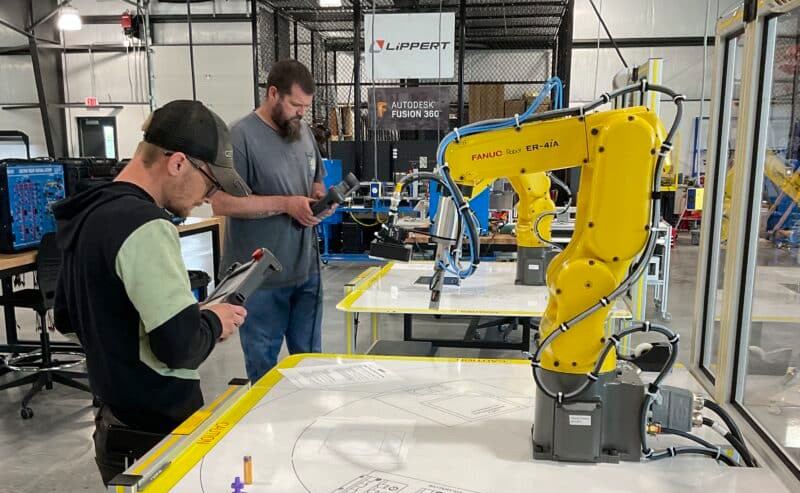
Mursix employee utilizing technology.

Susan Carlock views technology adoption from a couple of perspectives, but she sees the same lesson in both: A dedicated internal champion is essential to the process.

Carlock sees this truth both at Mursix, the 80-year-old supplier to automative, healthcare and other industries that she serves as executive vice president and co-owner, and at Murray Mentor, the two-year-old company she co-founded to help companies capture and share manufacturing-floor knowledge through AI.

At Mursix, Carlock learned first-hand the folly of simply adding tech-adoption responsibilities to someone’s plate. She once tried to take on the role alongside her other duties, but she struggled to give it the attention it needed. More recently, she has seen how important a dedicated tech-adoption lead can be as she has brought Murray Mentor to the marketplace. Following are lessons from those experiences.

Identify a dedicated technology champion.

Manufacturing runs on lean margins, Carlock notes, which means everybody works with a packed list of responsibilities and defined metrics. That makes it hard for someone to add tech adoption to their job and make it a priority. Even if it can’t be someone’s sole responsibility, off-load some of your champion’s other tasks so they can focus on tech adoption, or split the role among team members. “You owe it to your business to have a technology leader,” she says. “Whether it’s just one person or a team, you owe it to the future of your business.”

Make sure it’s the right person. 

Carlock says one Murray Mentor client stumbled because the wrong person was put into the champion role. Once an adjustment was made, the program got traction and became so successful within the organization that the client renewed for a second year. Finding that person early in the tech-adoption process is important, too, Carlock says, something the Murray Mentor team believes so adamantly that they will speak up quickly if they think the wrong person is guiding the effort. “They can pretty much tell you on the first day if that champion’s going to work,” she says. 

“You owe it to your business to have a technology leader. Whether it’s just one person or a team, you owe it to the future of your business.”
Susan Carlock
Executive Vice President, Mursix

Put a team around that person.

Don’t expect the champion to work solo and make things happen. Give that person a team and get it involved early. Pull from various departments for guidance on technology needs, deployment, problems and solutions. And the time commitment may be smaller than you think — dedicating just 2-4 hours a week to tech adoption efforts can be enough to move the needle. A bonus: They’ll become on-the-scene evangelists.

Make technology adoption a part of your strategic planning process.

Tech adoption won’t be taken seriously unless it is a part of your strategic planning process, Carlock says. That lets people know how important it is and gives leadership a stake in the project’s success.

Make technology adoption a priority or lose market share.

Technology is not an amenity or a luxury. It’s essential to competing, Carlock says. “As a small to mid-sized manufacturer, if you’re not doing some of these things, you’re waving to the competition as they drive by because you’re already behind.”

About Mursix

Founded in 1990 and based in Yorktown, Indiana, family-owned Mursix Corporation is a technology-driven manufacturing company known for skillfully solving a full scope of challenges in the manufacture of quality-critical, custom-engineered components. Today, Mursix is active in an expanding range of technology-driven sectors, including medical, alternative energy, automotive, and industrial markets.

Creating an Internal Support Team

The Missing Piece in Your Technology Strategy May Be a Champion Who Owns It

For manufacturing and logistics (AML) companies, adopting technologies like robotics, machine vision, advanced analytics or AI promises real gains in productivity and competitiveness. But technology alone rarely delivers transformation.

After speaking with hundreds of AML companies, Conexus Indiana has found a consistent differentiator: companies that treat technology adoption as an organizational priority, not a side project, are significantly more successful.

Why an Internal Champion Matters

Without clear ownership, even promising pilot projects stall.

That’s why successful adopters designate an internal champion, someone responsible for moving technology from exploration to implementation and driving the automation that delivers productivity gains. Recent Conexus surveys show about half of manufacturers have a dedicated Industry 4.0 leader or team and, in many cases, those are the companies making measurable progress. These champions connect leadership priorities with shop-floor realities, coordinate implementation and ensure the workforce is prepared to use new tools effectively. Critically, they understand the existing processes—an essential foundation for any automation effort.

What the Role Looks Like in Practice

In AML companies, this role goes by many names, including manufacturing engineer, process engineer, industrial engineer or automation engineer. The title varies, but the mission is consistently to make automation happen.

Automating a process that isn’t fully understood leads to compounded problems. Many processes also can’t be fully automated right away, or ever. A skilled manufacturing engineer knows how to semi-automate by identifying which steps in a workflow can be automated now, even when full automation isn’t yet feasible.

Another key distinction between an internal champion and an outside consultant is the fact that the internal person stays with the organization to monitor performance and troubleshoot issues. This ongoing oversight and maintenance is the fourth step in a successful technology adoption process, and it’s one that external resources often can’t replicate.

These champions don’t always require hiring a new staff member. In many cases, the right person is already on your team. It’s someone in an engineering or operations role who simply needs to be dedicated to this work. Others may come from technical training programs or apprenticeships designed to build exactly these skills.

The Challenge for Small and Mid-Sized Companies

For SMEs, dedicating someone to technology adoption is hard.

Lean teams and tight margins make it tempting to stack innovation work onto someone already managing operations, engineering or IT. But research consistently shows this approach slows progress. When technology adoption becomes a third or fourth responsibility, daily production demands will win every time.

How to Build the Right Internal Structure

You don’t need a large innovation department. Start focused:

  1. Identify a clear internal champion.
    Designate a leader responsible for technology exploration and implementation.
    If hiring isn’t an option, reallocate someone’s time. Sometimes, your champion is
    already on staff and ready for a new challenge.
  2.  Protect time for the work.
    For most companies, technology adoption cannot be an “extra task.” Make it part of someone’s core responsibilities, and create incentives to prioritize it. Without them, the daily work will always take over.
  3. Connect to external expertise.
    Industry organizations, tech integrators, and peer networks can accelerate learning and help you avoid common pitfalls. Ensure your champion has access to a network of peers, such as the Conexus Indiana Advanced Industries Council, who share relevant tech adoption learnings freely.

Adopting New Technology Starts With Asking the Right Questions

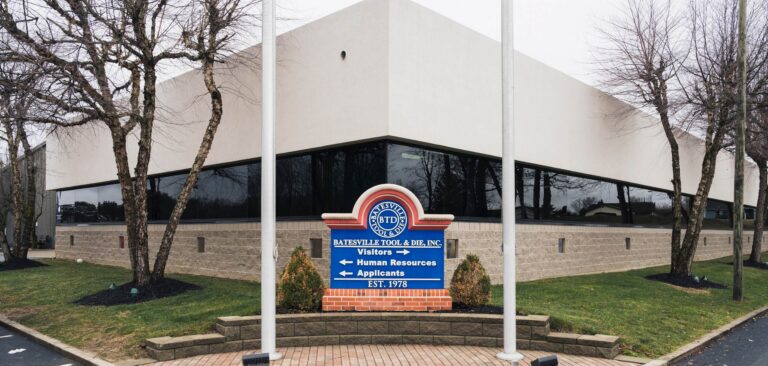
Batesville Tool & Die

Batesville, IN

For the team at Batesville Tool & Die, the big question isn’t, “Should we automate?” but, rather, “What should we automate next?”

“I tell people we’re spending as much money as we can possibly spend on automation, because it’s got the best return,” says Batesville Tool & Die President Bob Holtel.

A contract manufacturer that does much of its business with the automotive industry, Batesville Tool & Die succeeds by offering high-volume, high-speed work with the fewest flaws possible, a value proposition that’s always ripe for automation, Holtel says. Successfully deciding how and when to deploy automation relies on posing the right questions, he suggests.

Following are some that the Batesville Tool & Die recommend asking:

What do we do a lot of today and what will we benefit from for the next 5-7 years?

Pull together a diverse team/assign a project leader. This could seem like an unexpected priority for tech adoption, but Holtel believes it is an essential question. “Have somebody that’s a good communicator leading the team so you can extract as much information as possible out the group of people who are actually going to use the machine,” he says. 

What’s the goal? Are we looking for efficiency, speed, improved quality, safety or all
of the above? 

Once you identify the opportunity, start exploring different options for automation. Don’t buy technology for technology’s sake or let a vendor push you into something that won’t deliver a return. Instead, Holtel says, talk to your people, assess your goals and always ask, “What are we trying to accomplish?”

“You’ve got to take a leap of faith at some point. You’ve got to say, ‘OK. We’re going to go for it.”
Bob Holtel
President, Batesville Tool & Die

Who are the best team members and who is the best facilitator to lead the project? 

Nord puts structure around solution hunting when possible. For example, when his team goes to industry trade shows, they meet beforehand to discuss who will research specific problems and solutions. “Everybody has an assignment,” he says. After the show, they discuss what they saw and whether they should learn more. 

Can you show me? 

Vendors have plenty of good technology to sell you. Your job is to make sure they’re offering something that will do what you need it to do. Holtel says businesses should challenge vendors to “show me you’ve done something similar before and take me to your customer that has used your technology.”

What would the solution look like?

 Challenge the team to create a vision of your solution. “Ask them, ‘OK, what’s it look like physically and technology-wise?’” Holtel says. “Then you come up with a proposal, and you start putting it all together.”

Test your concept…Will it work?

 For its automation efforts, Batesville Tool & Die sets up a small-scale testing space that allows team members to see how machines integrate, what’s possible and where the kinks might be. Still, Holtel says, change will always come with some risk. “You’ve got to take a leap of faith at some point,” he says. “You’ve got to say, ‘OK. We’re going to go for it.’”

What are our metrics?

Holtel still has notes he wrote when his team started planning one automation project, including metrics scribbled to measure impact. Now he can rattle off numbers and conclude, “It met expectations.”

What’s next?

Constantly look for the next opportunity, Holtel says. “Automation leads to other automation, right?” he says. “You build confidence when you do something right and improve what you didn’t like on the last machine”.

About Batesville Tool & Die

Batesville Tool & Die, Inc., headquartered in Batesville, Indiana since 1978, is a leader in precision metal stamping and innovative manufacturing solutions. With a global presence and decades of expertise, BTD is dedicated to delivering exceptional quality and driving innovation in the manufacturing industry and operates state-of-the-art facilities with other 75 presses ranging from 50 to 1,200 tons. To learn more, visit www.btdinc.com

Getting to ‘Yes’ on New Technology Requires Timing, Process and Risk

Indiana Furniture

Jasper, IN

A lot of companies fret about implementing technology. Indiana Furniture VP of Operations Chad Nord says that’s the easy part. Far harder is making the decision to acquire technology. But it’s a challenge that can be overcome by watching carefully for the right technology at the right time and at the right price.

“It’s that convergence of ‘I’ve got a problem, there’s an opportunity for us to fix it and now we found a technology that’s the right size, it’s the right time, it’s the right cost,’” he says. “Getting all those things to converge, that’s the hard part.”

Indiana Furniture meets this challenge by being intentional about tech adoption decisions. Following are highlights of the company’s process.

Begin with the Problem

Don’t pursue technology because it’s exciting, because others have adopted it or for other less-than-strategic reasons. Start with the problem you’re trying to solve, then consider how tech can address it. “It’s about knowing what the problems are,’” Nord says, “It’s, ‘I want to fix this problem and this technology will fix it.’”

Constantly Watch for Solutions

Nord urges his entire team to track industry developments, pay attention to peers and watch for the solutions. “I want everybody finding this stuff,” he says.

Formalize the Process

Nord puts structure around solution hunting when possible. For example, when his team goes to industry trade shows, they meet beforehand to discuss who will research specific problems and solutions. “Everybody has an assignment,” he says. After the show, they discuss what they saw and whether they should learn more. 

“It’s about knowing what your problems are. It’s about knowing what those opportunities are. And then just keeping your eyes wide open.”
Chad Nord
VP of Operations, Indiana Furniture

Have a “Someday” List

Some problems emerge before solutions; some solutions arrive before you’re ready. Have an ongoing “someday” list of problems and technology so you are ready to move when the time is right. Review it regularly so you don’t miss opportunities. 

Have a Checkbook, not a Credit Card

Indiana Furniture is committed to funding tech exploration and adoption through a dedicated line item … with limits. Nord describes his tech-adoption budget as more checkbook than credit card, and says a big expenditure in one year could affect that budget for a few years. “It’s fill the piggy bank, break the piggy bank, fill it back up,” he says.

Accept Risk

All change comes with risk. The trick is minimizing that risk, and • Have a “someday” list. Some problems emerge before solutions; some solutions arrive before you’re ready. Have an ongoing “someday” list of problems and technology so timing is a key factor. Nord says he learned this the hard way with one particular initiative in which being on the cutting edge meant jumping in before vendors had developed integrated controls and accessories. Indiana Furniture had to create a lot of tools to complement the new technology, which resulted in added time and expense. “If I had it to do over again, I would have waited two more years,” he says.

Technology Spotlight

Autonomous Mobile Robots (AMRs)

Five years ago, Indiana Furniture deployed one AMR as an experiment. Today, a fleet of AMRs moves pallets of parts between processes around the clock — traveling more than 2,000 miles each year, fully autonomously. No manual triggers or human direction. Just intelligent, self-directed movement that keeps production flowing.

About Indiana Furniture

Founded on St. Patrick’s Day in 1905, Indiana Furniture began as Jasper Novelty Works — a community-driven effort by Dubois County residents to create local jobs by leveraging the region’s abundant hardwood forests. Today, more than a century later, the privately-owned company remains rooted in Jasper, Indiana, with descendants of its original founders still among its owners. As one of the anchors of Southern Indiana’s nationally recognized office furniture manufacturing cluster, Indiana Furniture has grown into a name synonymous with quality craftsmanship and innovative design, with showrooms across the country. To learn more, visit www.IndianaFurniture.com.

Case Study Header

Lorem ipsum dolor sit amet, consectetur adipiscing elit, sed do eiusmod tempor incididunt ut labore et dolore magna aliqua. Ut enim ad minim veniam.

Table of Contents

Lorem ipsum sit dolor

Lorem ipsum dolor sit amet, consectetur adipiscing elit, sed do eiusmod tempor incididunt ut labore et dolore magna aliqua. Ut enim ad minim veniam, quis nostrud.

Lorem ipsum dolor sit amet, consectetur adipiscing elit, sed do eiusmod tempor incididunt ut labore et dolore magna aliqua. Ut enim ad minim veniam, quis nostrud exercitation ullamco laboris nisi ut aliquip ex ea commodo consequat. Duis aute irure dolor in reprehenderit in voluptate velit esse cillum dolore eu fugiat nulla pariatur. Excepteur sint occaecat cupidatat non Link Example culpa qui officia deserunt mollit anim id est laborum.

Lorem ipsum dolor sit amet, consectetur adipiscing elit, sed do eiusmod tempor incididunt ut labore et dolore magna aliqua. Ut enim ad minim veniam, quis nostrud exercitation ullamco laboris nisi ut aliquip ex ea commodo consequat. Duis aute irure dolor in reprehenderit in voluptate velit esse cillum dolore eu fugiat nulla pariatur. Excepteur sint occaecat cupidatat non proident, sunt in culpa qui officia deserunt mollit anim id est laborum. Lorem ipsum dolor sit amet, consectetur adipiscing elit, sed do eiusmod tempor incididunt ut labore et dolore magna aliqua. Ut enim ad minim veniam, quis nostrud exercitation ullamco laboris nisi ut.

Lorem ipsum sit dolor

Lorem ipsum dolor sit amet, consectetur adipiscing elit, sed do eiusmod tempor incididunt ut labore et dolore magna aliqua. Ut enim ad minim veniam, quis nostrud exercitation ullamco laboris nisi ut aliquip ex ea commodo consequat. Duis aute irure dolor in reprehenderit in voluptate velit esse cillum dolore eu fugiat nulla pariatur. Excepteur sint occaecat cupidatat non proident, sunt in culpa qui officia deserunt mollit anim id est laborum. Lorem ipsum dolor sit amet, consectetur adipiscing elit, sed do eiusmod tempor incididunt ut labore et dolore magna aliqua. Ut enim ad minim veniam, quis nostrud exercitation ullamco laboris nisi ut.

Lorem ipsum sit dolor

Lorem ipsum sit dolor

Lorem ipsum dolor sit amet, consectetur adipiscing elit, sed do eiusmod tempor incididunt ut labore et dolore magna aliqua. Ut enim ad minim veniam, quis nostrud.

Lorem ipsum dolor sit amet, consectetur adipiscing elit, sed do eiusmod tempor incididunt ut labore et dolore magna aliqua. Ut enim ad minim veniam, quis nostrud exercitation ullamco laboris nisi ut aliquip ex ea commodo consequat. Duis aute irure dolor in reprehenderit in voluptate velit esse cillum dolore eu fugiat nulla pariatur. Excepteur sint occaecat cupidatat non Link Example culpa qui officia deserunt mollit anim id est laborum.

Lorem ipsum dolor sit amet, consectetur adipiscing elit, sed do eiusmod tempor incididunt ut labore et dolore magna aliqua. Ut enim ad minim veniam, quis nostrud exercitation ullamco laboris nisi ut aliquip ex ea commodo consequat. Duis aute irure dolor in reprehenderit in voluptate velit esse cillum dolore eu fugiat nulla pariatur. Excepteur sint occaecat cupidatat non proident, sunt in culpa qui officia deserunt mollit anim id est laborum. Lorem ipsum dolor sit amet, consectetur adipiscing elit, sed do eiusmod tempor incididunt ut labore et dolore magna aliqua. Ut enim ad minim veniam, quis nostrud exercitation ullamco laboris nisi ut.

“Lorem ipsum dolor sit amet, consectetur adipiscing elit, sed do eiusmod tempor incididunt ut labore et dolore magna aliqua. Ut enim ad minim veniam, quis nostrud exercitation ullamco.”
John Doe
Designer
Lorem ipsum sit dolor

Lorem ipsum sit dolor

Lorem ipsum dolor sit amet, consectetur adipiscing elit, sed do eiusmod tempor incididunt ut labore et dolore magna aliqua. Ut enim ad minim veniam, quis nostrud.

Lorem ipsum dolor sit amet, consectetur adipiscing elit, sed do eiusmod tempor incididunt ut labore et dolore magna aliqua. Ut enim ad minim veniam, quis nostrud exercitation ullamco laboris nisi ut aliquip ex ea commodo consequat. Duis aute irure dolor in reprehenderit in voluptate velit esse cillum dolore eu fugiat nulla pariatur. Excepteur sint occaecat cupidatat non Link Example culpa qui officia deserunt mollit anim id est laborum.

“Lorem ipsum dolor sit amet, consectetur adipiscing elit, sed do eiusmod tempor incididunt ut labore et dolore magna aliqua. Ut enim ad minim veniam, quis nostrud exercitation ullamco.”
John Doe
Designer
Lorem ipsum sit dolor

Lorem ipsum sit dolor

Lorem ipsum dolor sit amet, consectetur adipiscing elit, sed do eiusmod tempor incididunt ut labore et dolore magna aliqua. Ut enim ad minim veniam, quis nostrud.

Lorem Ipsum Sit Dolor

Lorem ipsum dolor sit amet, consectetur adipiscing elit, sed do eiusmod tempor incididunt ut labore et dolore magna aliqua. Ut enim ad minim veniam, quis nostrud exercitation ullamco laboris nisi ut aliquip ex ea commodo consequat. Duis aute irure dolor in reprehenderit in voluptate velit esse cillum dolore eu fugiat nulla pariatur. Excepteur sint occaecat cupidatat non Link Example culpa qui officia deserunt mollit anim id est laborum.

Lorem Ipsum Sit Dolor

Lorem ipsum dolor sit amet, consectetur adipiscing elit, sed do eiusmod tempor incididunt ut labore et dolore magna aliqua. Ut enim ad minim veniam, quis nostrud exercitation ullamco laboris nisi ut aliquip ex ea commodo consequat. Duis aute irure dolor in reprehenderit in voluptate velit esse cillum dolore eu fugiat nulla pariatur. Excepteur sint occaecat cupidatat non Link Example culpa qui officia deserunt mollit anim id est laborum.

Lorem Ipsum Sit Dolor

Lorem ipsum dolor sit amet, consectetur adipiscing elit, sed do eiusmod tempor incididunt ut labore et dolore magna aliqua. Ut enim ad minim veniam, quis nostrud exercitation ullamco laboris nisi ut aliquip ex ea commodo consequat. Duis aute irure dolor in reprehenderit in voluptate velit esse cillum dolore eu fugiat nulla pariatur. Excepteur sint occaecat cupidatat non Link Example culpa qui officia deserunt mollit anim id est laborum.