
Cobots increase efficiency and quality for company making products that protect young lives

Dorel Juvenile

Automation supports a passion for precious cargo

As its Canadian parent’s only North American manufacturing site, Columbus’ Dorel Juvenile facility produces car seats and other safety products for children. A quest for increased efficiency led the firm to cobots and delivered impact that extends beyond the production line.

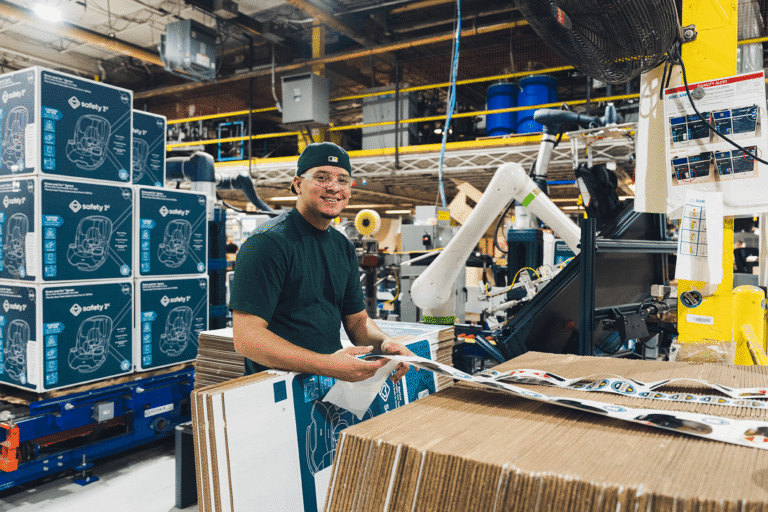
Jose Garcia leaves no doubt in your mind how impressed he is with the automation that has been added to the production line at Columbus’ Dorel Juvenile facility, where he serves as plant manager.

“It’s a sexy beast,” he says. “There are four different robots in a symphony.”

Despite his obvious enthusiasm, Garcia wouldn’t swoon over any robot in any situation. Experience has taught him that it takes the right automation in the right role with the right people to get the most out of the advancements driving Industry 4.0.

As one might expect from a company tasked with saving children’s lives, Dorel Juvenile dedicates itself to engineering the safest products possible, using scientific molding processes to ensure the manufacturing process itself plays a role in product strength and durability and it employs three crash sleds on site to simulate car crashes for testing.

Over the years, the plant has sought opportunities to increase automation but has found its options limited. Because so much of the labor for Dorel Juvenile products involves working with belts and fabrics, threading them through and around plastic seats, headrests and bases, some of the processes simply can’t be automated at a high level of quality and consistency. Such challenges – and a shortage of talent who could make automation work – forced the company to abort past automation efforts.

One key that made the current automation push effective was the addition of Director of Technical Services Jeff Echler. After he joined the company in 2021, Echler reviewed the production process and identified one area where automation could work: packing and distribution. The bonus? Automation would not only increase efficiency but would also improve worker safety, make better use of the existing workforce and increase quality.

The solution: Focused automation

Because not every step of Dorel Juvenile’s production process can be automated, the company worked to get the biggest impact from the area it could automate, and to help its workforce see the benefits. 

On a production line that relies on human handwork for key activities, Dorel Juvenile knew it couldn’t automate every task, but it did recognize that automation at the end of its production line could allow it to increase efficiency and redeploy workers to more value-added tasks by relieving them of the following activities:

  • box assembly
  • placing products into boxes
  • labeling
  • putting boxes on pallets
  • labeling pallets.
  • moving filled pallets to the warehouse
“As long as you have that open communication and are able to reassure them that we’re not here to take their job away, and once they are able to experience it, people are thinking, ‘Hey, this is really cool.’”
Jeff Echler
Director of Technical Services, Dorel Juvenile

At the same time that Echler and his team identified these steps as opportunities for automation, they also recognized the limitations they faced. Space is limited in the Dorel Juvenile plant, so he had to choose equipment that wouldn’t dominate the floor or act as “monuments” that had to be worked around and that wouldn’t require a lot of safety fencing. With a need for production line flexibility, Dorel Juvenile had to have equipment that could be reconfigured and moved. Because labor – and especially skilled labor – is so hard to find, Echler sought automation that could be operated mostly by existing workers, albeit with training. He also recognized that, with products weighing up to 15 lbs., Dorel Juvenile would be stretching the capacity of many cobots and that, because Dorel strives for a one-year return on capital investments, the team had to find solutions with immediate impact.

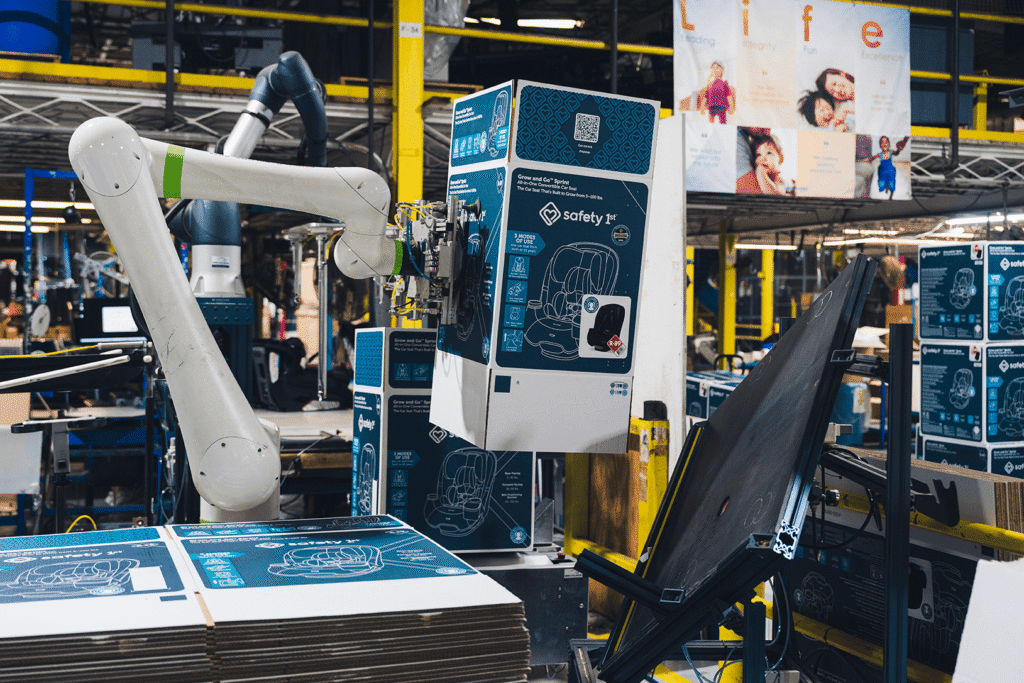
The solution for Dorel Juvenile was that “symphony” of four cobots working in collaboration with an autonomous mobile robot (AMR) at the end of the production line. The process starts when a cobot opens a flattened carboard carton into a box ready for a completed seat. Another cobot puts the seat into the box and closes it. A third cobot labels the box, and the final cobot stacks the packed, taped and labeled box onto a skid with other finished boxes. When the skid is fully loaded, the AMR moves it and replaces it with an empty one.
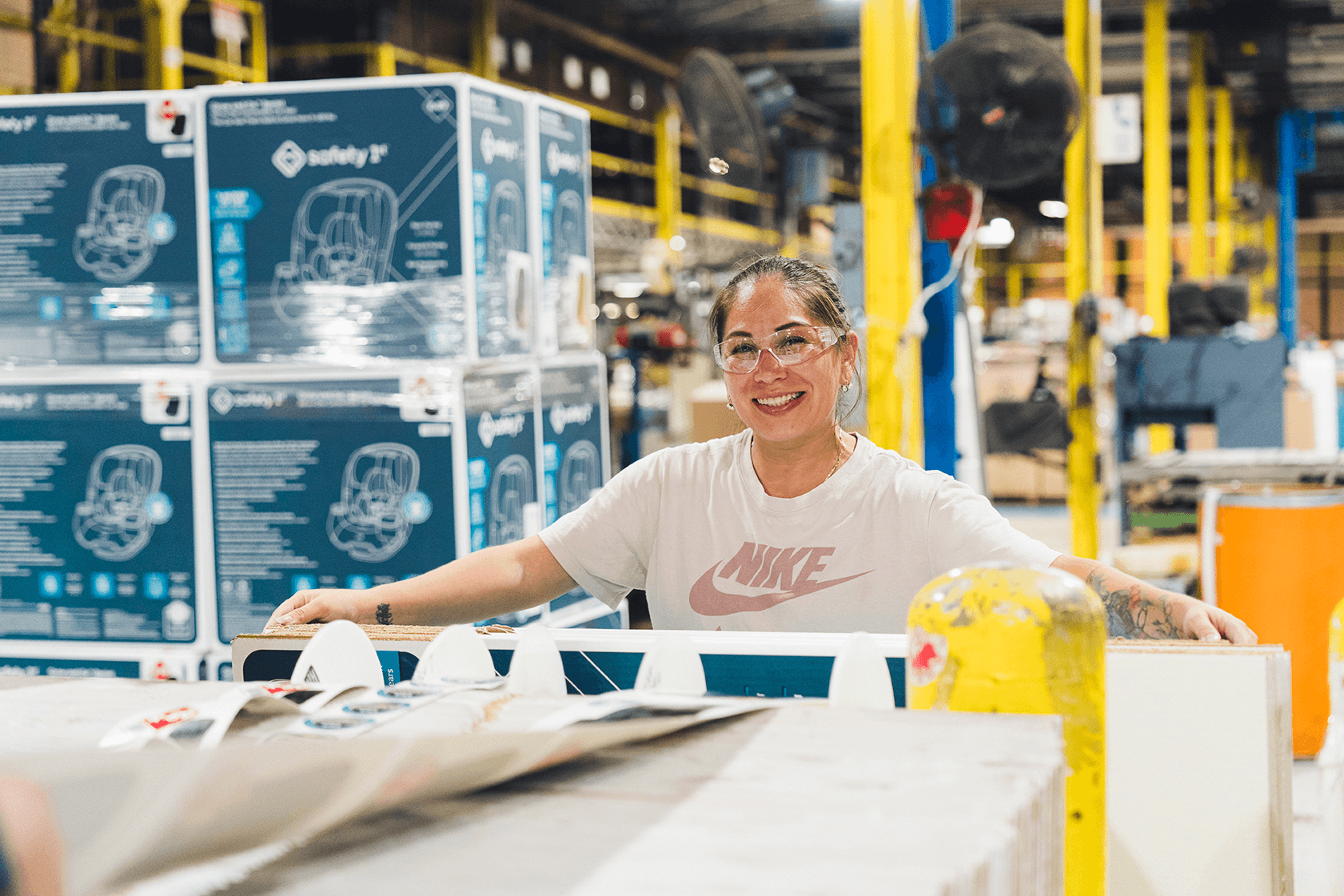
The workforce impact of this automation is multifaceted. First of all, in a market where it is difficult to hire workers, it frees people for tasks that require human skills. This reduces the pressure on Dorel Juvenile to constantly hire new workers and also provides current workers with opportunities to upskill and move into new roles. Plus, in a process that taxes the human body (Garcia points out that shoulder injuries from repetitive motion is the second most common injury among Dorel Juvenile workers), this automation protects workers from the dangers intrinsic to moving and stacking heavy.

As successful as the process has been for Dorel Juvenile, Echler is quick to say that there’s more to adding automation than buying robots. A company must be sharply aware of what the machines will be expected to do and identify how they’ll do it. Workplaces must be laid out and synchronized so robots aren’t colliding or interfering with each other. Systems must be in place for workers to communicate with automated components and for those components to communicate with each other.

Most important, Echler says, the workforce must be informed throughout the automation-adoption process and prepared for change. Workers should not be kept in the dark while automation is being investigated, only to be informed of the changes right before they occur. For Dorel Juvenile, this helped to calm fears. Sure, Echler says, some Dorel Juvenile employees initially were upset about the introduction of automation, worried that it would mean the elimination of their jobs but keeping workers aware and engaged reduced that apprehension. “As long as you have that open communication and reassure them that we’re not here to take their job away, and once they are able to experience it, people are thinking, ‘Hey, this is really cool,’” he says, “They also realize, ‘Yeah, I didn’t lose my job. I got to move to an easier job.’”
Key Learnings: Automation works, but people remain essential

Robots and cobots can do things efficiently, but they can’t share wisdom, care about customers or develop talent.

Dorel Juvenile couldn’t be happier with the return on its automation investment, but it will never pretend that robots and cobots can succeed without the right people working together toward a shared mission. Following are some lessons they shared while discussing the automation process.

Know your limitations.

As much as Dorel Juvenile had a vision for automating its operations, it also had a firm grasp of its limitations, such as space, workforce skills and budget. As a result, it didn’t acquire equipment and technology that would create more problems than solutions.

Vendors shouldn’t just sell you equipment and technology; they should provide expertise and support to make sure you get the most out of what you buy. For Dorel Juvenile, Rhino Tool House – a company Echler had worked with before – helped the team develop its automation package, design a plan for how it would work and transform that vision into reality.

Employees typically will see either danger or opportunity in automation. Show them the opportunity and you’ll help them overcome fear.


Garcia is quick to acknowledge that the automation process at Dorel Juvenile wouldn’t have happened without Echler’s background and expertise. Bringing him onboard allowed the company to do what it had attempted unsuccessfully in the past.

Don’t assume people are destined to stay in the jobs they’re hired for. Instead, watch for and cultivate people who have the capacity and desire to learn and do more, and provide opportunities for people who might otherwise get passed over. An added benefit of doing this? You’ll create loyalty that will keep people on your team.

Echler says he benefited early in his career from mentors who helped him develop into the engineer he is today. As such, he provides guidance to others. “If you’ve been rewarded by having somebody mentor and teach you and develop your skillset, to be able to pass that on is the best thing,” he says.

When Echler is working on a new idea, he not only runs it past his engineering colleagues but also shares it with his skilled trades people. This nets good ideas from both groups and builds up the team. “Having that collaboration, throughout all levels in the organization, just makes things stronger,” he says.

From its tagline (“Care for Precious Life”) to workplace conversations, Dorel Juvenile constantly reminds team members about what their product does, a practice Garcia says drives employee retention. “People know they’re making a difference,” he says. “You know, you can make car seats that are going to save little kids lives or you can go make widgets or something. We have, because of the product we make, a pretty low attrition rate.”