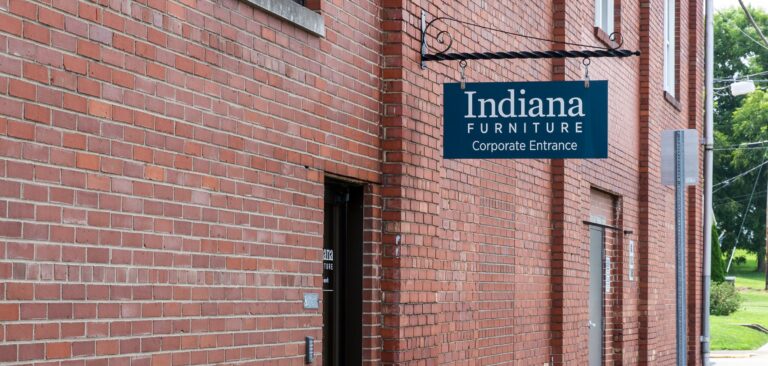
A lot of companies fret about implementing technology. Indiana Furniture VP of Operations Chad Nord says that’s the easy part. Far harder is making the decision to acquire technology. But it’s a challenge that can be overcome by watching carefully for the right technology at the right time and at the right price.
“It’s that convergence of ‘I’ve got a problem, there’s an opportunity for us to fix it and now we found a technology that’s the right size, it’s the right time, it’s the right cost,’” he says. “Getting all those things to converge, that’s the hard part.”
Indiana Furniture meets this challenge by being intentional about tech adoption decisions. Following are highlights of the company’s process.
Don’t pursue technology because it’s exciting, because others have adopted it or for other less-than-strategic reasons. Start with the problem you’re trying to solve, then consider how tech can address it. “It’s about knowing what the problems are,’” Nord says, “It’s, ‘I want to fix this problem and this technology will fix it.’”
Nord urges his entire team to track industry developments, pay attention to peers and watch for the solutions. “I want everybody finding this stuff,” he says.
Nord puts structure around solution hunting when possible. For example, when his team goes to industry trade shows, they meet beforehand to discuss who will research specific problems and solutions. “Everybody has an assignment,” he says. After the show, they discuss what they saw and whether they should learn more.
Some problems emerge before solutions; some solutions arrive before you’re ready. Have an ongoing “someday” list of problems and technology so you are ready to move when the time is right. Review it regularly so you don’t miss opportunities.
Indiana Furniture is committed to funding tech exploration and adoption through a dedicated line item … with limits. Nord describes his tech-adoption budget as more checkbook than credit card, and says a big expenditure in one year could affect that budget for a few years. “It’s fill the piggy bank, break the piggy bank, fill it back up,” he says.
All change comes with risk. The trick is minimizing that risk, and • Have a “someday” list. Some problems emerge before solutions; some solutions arrive before you’re ready. Have an ongoing “someday” list of problems and technology so timing is a key factor. Nord says he learned this the hard way with one particular initiative in which being on the cutting edge meant jumping in before vendors had developed integrated controls and accessories. Indiana Furniture had to create a lot of tools to complement the new technology, which resulted in added time and expense. “If I had it to do over again, I would have waited two more years,” he says.
Five years ago, Indiana Furniture deployed one AMR as an experiment. Today, a fleet of AMRs moves pallets of parts between processes around the clock — traveling more than 2,000 miles each year, fully autonomously. No manual triggers or human direction. Just intelligent, self-directed movement that keeps production flowing.

Founded on St. Patrick’s Day in 1905, Indiana Furniture began as Jasper Novelty Works — a community-driven effort by Dubois County residents to create local jobs by leveraging the region’s abundant hardwood forests. Today, more than a century later, the privately-owned company remains rooted in Jasper, Indiana, with descendants of its original founders still among its owners. As one of the anchors of Southern Indiana’s nationally recognized office furniture manufacturing cluster, Indiana Furniture has grown into a name synonymous with quality craftsmanship and innovative design, with showrooms across the country. To learn more, visit www.IndianaFurniture.com.