The four themes rising to the top of every President & CEO conversation and what they signal for Indiana’s advanced manufacturing and logistics sector.
Earlier this year, Conexus Indiana launched the President & CEO Network, bringing together executives of small and mid-sized manufacturing and logistics companies (which make up over 80% of the industry) for candid, peer-to-peer conversations.
Four themes surfaced in those discussions, regardless of industry sector, exact company size or location in Indiana. The themes are outlined below, with direct insights from industry presidents and CEOs.
1. Tariffs, materials costs and pricing volatility
The cost environment facing Indiana manufacturers is not a temporary disruption but a structural shift. Industry leaders report aluminum prices up roughly 30% since December, tungsten moving from $20 to $200 per pound and materials like steel tubing now purchased in small quantities from multiple suppliers, with no ability to stockpile or plan ahead. Freight surcharges also are climbing and rarely coming back down.
Additionally, for most, tariffs have not yet made domestic sourcing straightforwardly more competitive. The cost and quality gap with foreign suppliers remains for many manufacturers, even with tariffs applied.
The real operational issue is not any single price level but unpredictability. Manufacturers say they can plan for almost any stable condition. What stalls quoting, contracting and capital decisions is not knowing whether a quote made today will hold in 30 days.
The CEOs who are managing this best have shortened quote windows, built supplier redundancy into their sourcing strategies and shifted their value proposition toward specialized capability and speed–competing on what domestic manufacturing can do rather than what it costs.

2. Labor, workforce and frontline development
Indiana’s unemployment rate sits at 3.3%, and in manufacturing-dense areas like Elkhart County it’s even under 3%. The labor market is not loosening, and standard workforce attraction tools are not keeping pace.
The challenge emerging with CEOs is more specific than a headline number suggests. The pipeline of people qualified to lead a team, drive a process and hold others accountable feels particularly thin. This challenge exists with back-office and shop-floor roles, where there is an increasing need to engage with automation, digital systems and AI tools. With shop-floor roles, specifically, many lack the foundational skills to use those tools effectively.
Companies making progress are hiring for cultural fit and training in-house, building earn-and-learn partnerships and treating investment in technology as part of what makes a workplace worth joining. Network members report that candidates respond to shops that are modernizing and that technology is expanding and upgrading the nature of the work.
3. AI moving from curiosity to operations
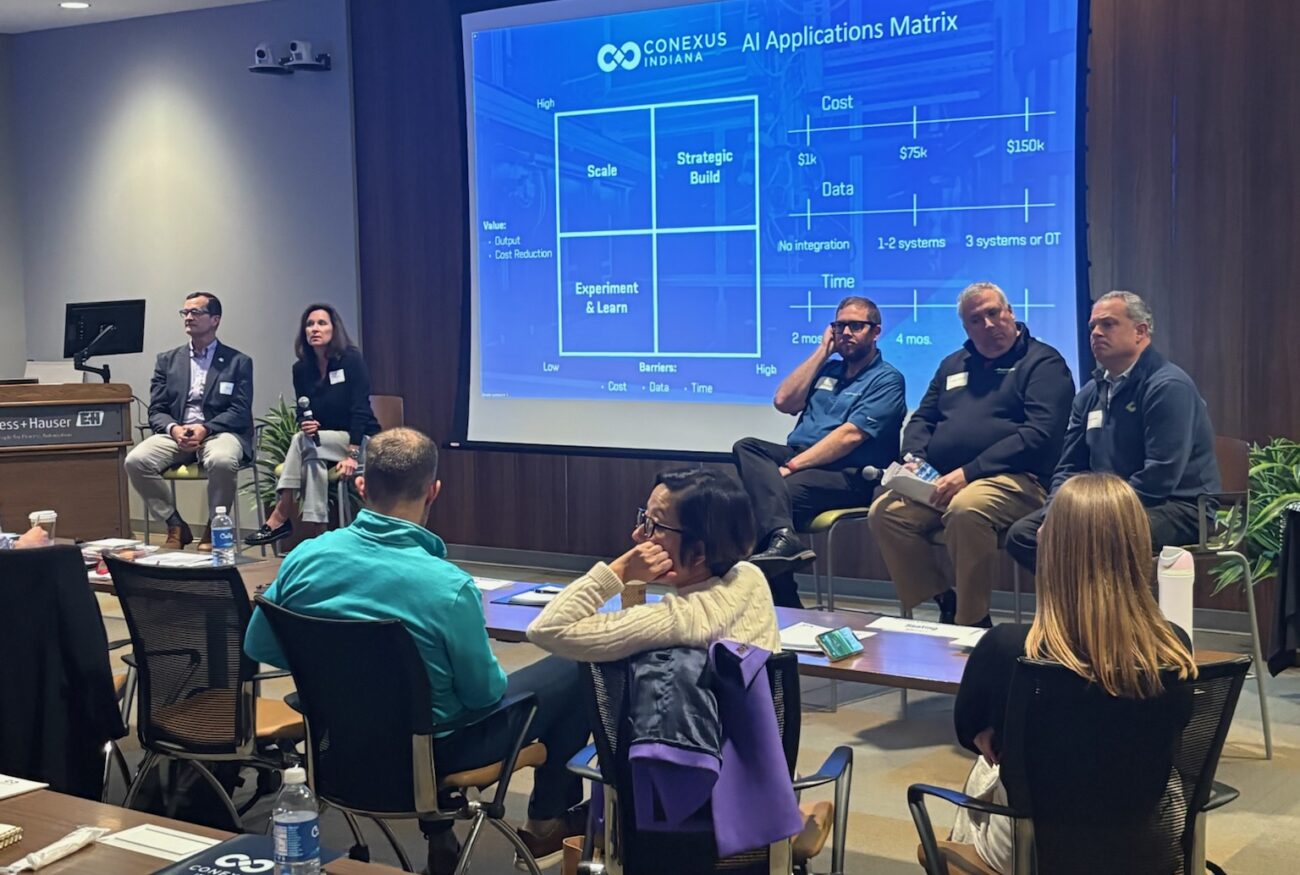
AI is no longer a future topic, but a current operational question for manufacturers of every size, and the range of adoption among CEOs and their teams is wide.
Some leaders are using AI daily, including Copilot for internal communications, Claude for custom tool-building and ChatGPT for research and preparation. One member’s team built a working sales support tool that pulls CRM data into prioritized weekly action plans per sales rep in under a month. Another is launching a third-shift AI deployment in July to preserve shop-floor knowledge that quality manuals don’t capture. Others are moving carefully, conducting internal surveys before drafting AI use policies, weighing data security concerns against productivity gains and seeking practical, process-specific applications.
The leaders making the most progress have concluded that not moving carries more risk than moving quickly. When it comes to early AI use, members report immediate value, with no data infrastructure required. See Conexus’ AML AI Use-case Catalog for specific examples.
4. Business systems, data visibility and AI governance
Behind every AI conversation is a foundational question about whether or not the organization’s data infrastructure is ready to support it.
ERP and CRM disconnection is a consistent blocker for progress, and has been for years. Companies with more integrated, better-organized systems are better positioned to use AI productively. Those working across legacy systems are finding that the systems question often needs to come before the AI question.
The data visibility gap shows up in concrete ways. Leaders frequently cannot track shipment cost per customer agreement, ROI per distributor or time spent per account. Without that visibility, decisions that should be data-driven stay intuition-driven.
On governance, companies making the most progress are following a deliberate sequence. They are establishing a clear vision at the leadership level, encouraging employee use and learning, then adding light governance and training with regular check-ins on what is working. Designating a security-focused role to support AI also is emerging as a best practice as AI-enabled risks grow alongside productivity gains. Members who have moved through this sequence report that having someone in this security role makes adoption more durable and the risks more manageable.
What’s to come
Over the coming weeks, Conexus will go deeper on each top priority, sharing member insights, peer-tested approaches and resources for companies navigating the same terrain.
Subscribe to the Conexus newsletter or follow us on LinkedIn to receive each installment as it publishes.