
Building on a history of innovation, Indiana manufacturer drives bus systems into the future with a product offering EV advantages without EV infrastructure and costs
Allison Transmission
Marion County Global Headquarters
13,500
Company Size

Allison Transmission builds on proven product to make reduced emissions practical
On the heels of a massive acquisition, global firm offers hybrid bus solution with geofencing feature
Today’s transit authorities are increasingly seeking propulsion solutions that offer a balance of operational flexibility and advanced capabilities with innovative technology. Hybrid-drive technology from Allison Transmission allows buses to operate in EV mode around transit stops, stations, high-population zones and other areas, all without a massive investment in all-electric buses and their infrastructure.
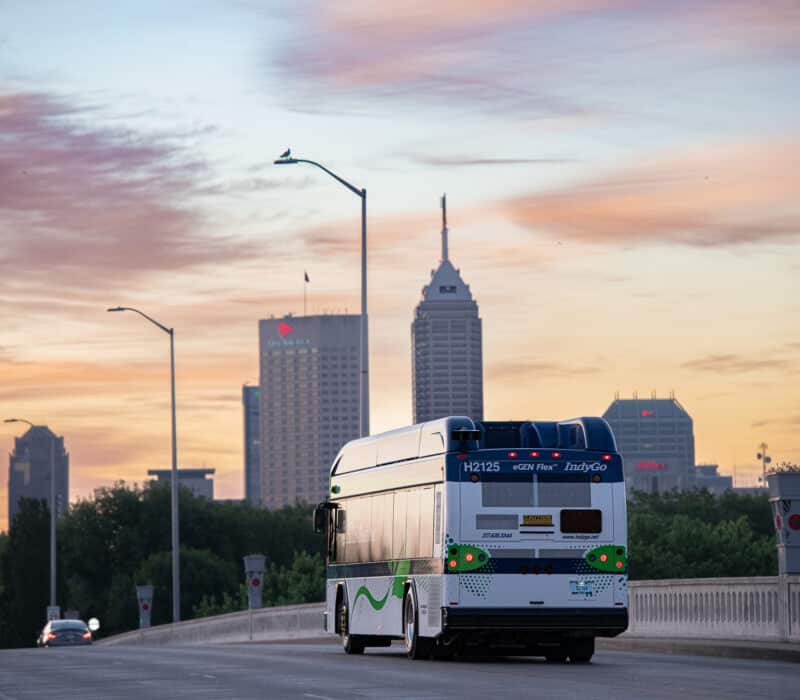
Allison Transmission’s eGen Flex hybrid-propulsion system allows buses to switch automatically from diesel to all-electric for up to 10 miles at a time. Designed to respond to geofencing, the eGen Flex can operate in “engine-off mode” in specific areas while still moving and maintaining all onboard functions, including air conditioning, heating and communications systems.
And while the product is relatively new – having been introduced in 2021 – it’s built on a time-tested and familiar foundation: the H 40/50, a hybrid system that’s logged billions of miles since it hit the road in 2003.
A decades-long commitment to blending tried-and-true with cutting-edge has made Allison Transmission a global leader in propulsion systems for large commercial and defense vehicles. Launched in Indianapolis in 1915 as the Speedway Motor Company, founder James Allison was also a key figure in the development of the Indianapolis Motor Speedway and the Indianapolis 500. The company was purchased by General Motors after Allison’s 1928 death and spun off to a private equity group in 2007 before going public in 2012.
While Allison Transmission has expanded steadily over the years, the company grew substantially in January 2026 when it acquired Dana Incorporated’s Off-Highway Drive & Motion Systems business for approximately $2.7 billion. The acquisition added roughly 10,000 employees to Allison Transmission’s employee workforce.
The bus-propulsion segment is an important element of Allison’s international portfolio and a key area of its value proposition. As the industry evaluates the potential scope and extent of electrification, the company support transit fleets during this period by offering the eGen Flex™. Allison positions its electric-hybrid solution as a bridging technology that offers advanced capabilities for today’s operational requirements.

A winning combination of ‘proven’ and ‘cutting edge’
eGen Flex helps bus operators deliver EV operation without breaking their budgets
The slow pace of the transition to full EV bus adoption doesn’t faze the team at Allisson Transmission. After all, they’ve been working on it for years already, having launched the company’s first electric-hybrid bus transmission in 2003. Since then, Allison Transmission has put thousands of its electric hybrid units on the road and logged billions of miles.
While customers have been satisfied with the cost savings and environmental benefits they get from the H 40/50, more recently they’ve experienced increasing demand for lowered emissions in certain sensitive areas. To address that demand, in 2021 the team at Allison Transmission introduced a disconnect clutch that allows a bus to operate with the diesel engine turned off.
Making this option especially attractive to bus operators is the fact that it is built on the tried-and-true H 40/50. This allows customers to make a leap into the zero-emissions world more comfortably and without the extra costs of converting to an all-electric system, which typically would include not only new buses but also charging stations and other expenses.
“The eGen Flex is helping cities meet sustainability goals without the need for additional infrastructure,” said James Tellus, Allison Transmission National Accounts Manager. “It creates a lower total cost of ownership of the complete ecosystem versus full-electric options.”
The eGen Flex’s geofencing feature switches a bus to engine-off mode in particular areas, meaning riders at bus stops, people around transit stations and others in targeted areas aren’t subjected to the exhaust or noise of a diesel engine. Because the switch is automatic, drivers don’t have to worry about triggering it and riders typically aren’t aware anything has changed.
Range anxiety – worries about how far an EV can go between charges – is as present in the transit industry as it is with car buyers, Tellus says, inhibiting municipalities’ ability to go all-electric. The eGen Flex addresses that anxiety by delivering long stretches of operation in EV mode without the worry that the battery will run out of charge and leave a bus stranded.
Key Learnings: Feel your customers’ pain, consider your partners’ challenges
Collaboration is key to developing and successfully deploying EV technology
EV technology is similar to other technology in that adoption might seem inevitable, but you won’t succeed if your customers and partners aren’t ready to adopt what you’re offering. Even if the marketplace is pushing toward a new future, run too far ahead of the crowd and you’ll be running alone.
To make sure they weren’t rushing ahead too quickly, the team at Allison Transmission developed a product that would address their customers’ needs without pushing them into unchartered territory. The following are some lessons they offer from their experiences.
Ease their pain. In recent years, as the team at Allison Transmission saw their bus-propulsion customers being pressured to run in full EV mode, they also saw them struggling to respond without breaking their budgets. Sean Miller, Allison Transmission Director of Global Strategic Marketing, says, “Our customers were sitting there saying, ‘I don’t think there’s any way we can get to some of these goals. So, what’s my next, best alternative?’” Allison Transmission introduced a solution that allows municipalities to meet those demands.
Build on a solid foundation. While the eGen Flex is a newer product, it’s built on technology that hasn’t been radically changed since it was launched more than 20 years ago. “We continue to do incremental changes,” Miller said. “Some of the components of the system changed over time, but ultimately the system was pretty similar.”
Be a good partner. Don’t create a product in your shop and expect it to magically integrate with customers’ systems and expectations. Work with partners throughout the product development process so your final product is ready to go to work on day one. “We have dedicated customer-integration engineers that, on a daily basis, are really dedicated to the OEMs to make sure that this product is launched successfully and meets the customers’ needs,” Tellus said.
Get your team excited. Nothing excites a technical team like the opportunity to do something that hasn’t been done. With the eGen Flex, Allison Transmission challenged its engineers to solve a problem, and you can tell by the way they talk about it that they’re proud of what they accomplished. “Because the parameters are established before the bus leaves the depot, the eGen Flex seamlessly shifts between engine-on and engine-off modes during operation,” Miller says. “It is an exceptionally well-engineered system that operates entirely independent of driver intervention.”